What Is a Barleycorn Measurement? Secret Behind Sizing 2026
One barleycorn equals exactly 1/3 inch (8.47 mm) and it’s the hidden unit behind every shoe size number you’ve worn your entire life. This ancient grain-based measurement is the reason a UK size 8 shoe is exactly 1/3 inch longer than a size 7, and why shoe sizes follow such a perfectly consistent pattern worldwide.
Whether you’re shopping for shoes online, comparing UK and US sizes, or simply curious why shoe sizing works the way it does, understanding the barleycorn measurement gives you an instant reference point.
Quick Conversion Box
1 barleycorn = 0.333 inches 1 barleycorn = 8.47 millimeters 1 barleycorn = 0.847 centimeters 1 barleycorn = 0.0278 feet
How Barleycorn Measurement Works in Modern Shoe Sizing
The barleycorn (8.47 mm) is one of the oldest units of measurement in the English system. English traders and cobblers in the 14th century literally lined up dried barleycorn grains to measure shoe lengths three grains equaled one inch, so one grain equaled exactly 1/3 inch (8.47 mm).
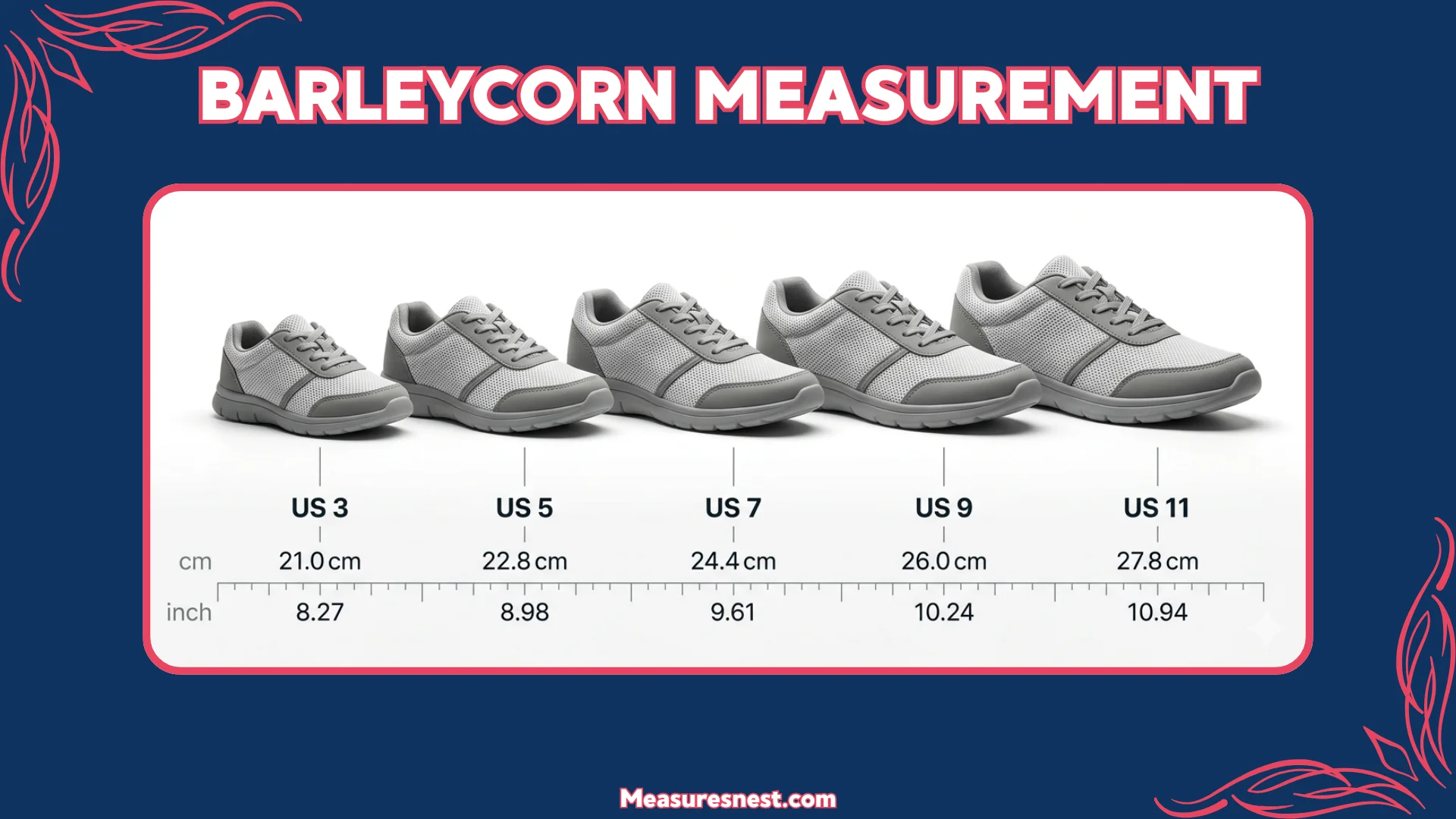
Every single whole shoe size you see on a label represents exactly one barleycorn (1/3 inch / 8.47 mm) of additional foot length. A UK men’s size 1 corresponds to a foot length of 4 inches (10.16 cm) and every size above that adds exactly one barleycorn. So a size 10 shoe equals a foot length of 4 inches + 9 barleycorns = 7 inches (17.78 cm).
The system extends to half sizes too. A half size represents exactly half a barleycorn (1/6 inch / 4.23 mm). This is why jumping from a size 9 to a size 9.5 gives you only a very small change in shoe length not a full third of an inch, but exactly half of one.
The Shoe Size Formula Explained
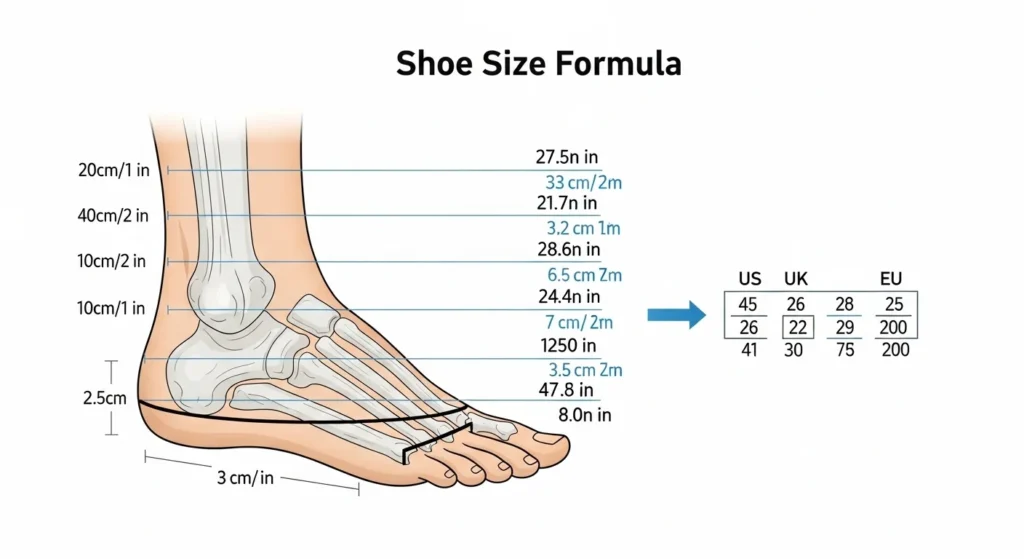
The barleycorn formula for UK shoe sizes works like this:
UK Shoe Size = (Foot length in inches − 4) × 3
So if your foot measures 10 inches (25.4 cm) long:
- Subtract 4 → 6 inches remain
- Multiply by 3 → UK size 18
And working backwards from a size:
Foot length = (UK size ÷ 3) + 4 inches
For a UK size 9:
- 9 ÷ 3 = 3
- 3 + 4 = 7 inches (17.78 cm)
This formula gives cobblers, shoe retailers, and sports footwear fitters an exact way to calculate the right shoe size from any foot measurement.
How UK, US, and EU Sizes Relate to Barleycorn
The barleycorn system explains the confusing gaps between UK, US, and European shoe sizes.
| System | Based On | Size Difference Per Unit | Zero Point |
|---|---|---|---|
| UK | Barleycorn (1/3 inch) | 1/3 inch (8.47 mm) | 4 inches (10.16 cm) foot |
| US Men’s | Barleycorn (1/3 inch) | 1/3 inch (8.47 mm) | Offset +1 from UK |
| US Women’s | Barleycorn (1/3 inch) | 1/3 inch (8.47 mm) | Offset +2 from UK |
| EU (Mondopoint) | Paris Point (2/3 cm) | 6.67 mm | Different zero point |
US men’s sizes run 1 size larger than UK sizes. A UK size 9 equals a US men’s size 10. US women’s sizes run 2 sizes larger than UK. A UK size 7 women’s equals a US women’s size 9. European sizes use the Paris Point system instead of barleycorn one EU size equals 6.67 mm (0.263 inches) of foot length, slightly less than one barleycorn.
Shoe shoppers buying online internationally use this barleycorn-anchored comparison every day. Knowing that UK and US men’s sizes differ by exactly one barleycorn-based increment helps you avoid expensive sizing mistakes.
Children’s Shoe Sizes and Barleycorn
Children’s shoe sizes use the same barleycorn system but start from a different zero point. UK children’s sizes begin at size 0, which corresponds to a foot length of 4 inches (10.16 cm). Each size up adds exactly one barleycorn (1/3 inch / 8.47 mm), just like adult sizes.
| UK Children’s Size | Foot Length (inches) | Foot Length (cm) |
|---|---|---|
| Size 1 | 4.33 in | 11.0 cm |
| Size 3 | 5.0 in | 12.7 cm |
| Size 5 | 5.67 in | 14.4 cm |
| Size 8 | 6.67 in | 16.9 cm |
| Size 10 | 7.33 in | 18.6 cm |
| Size 13 | 8.33 in | 21.2 cm |
Children’s footwear specialists, school shoe fitters, and pediatric podiatrists use these barleycorn-based increments to track foot growth. Most children’s feet grow one to two shoe sizes (1 to 2 barleycorns) per year in their early years.
The Accuracy and Limitations
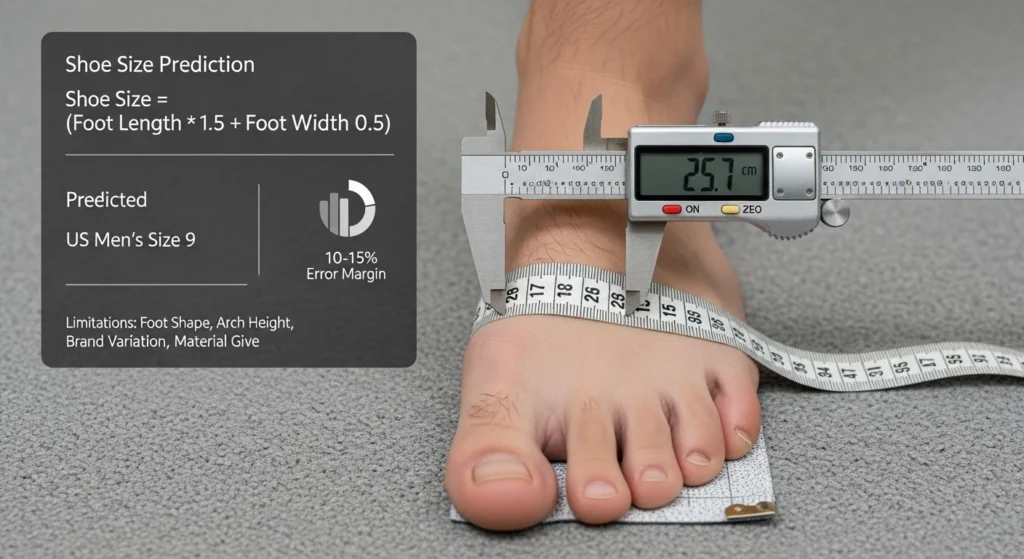
The barleycorn system is remarkably consistent but it has real-world limitations you should understand before buying shoes, especially online.
Foot shape varies widely. Two people with the same foot length in barleycorn units can have very different foot widths, arch heights, and toe shapes. The barleycorn system only accounts for length, not width. Width fittings (A, B, D, E, EE, EEE in UK sizing) add a separate layer of measurement that barleycorn alone doesn’t cover.
Manufacturing tolerances exist. Even the best shoe factories produce shoes with slight variations typically within ±2 mm (±0.08 inches) of their stated barleycorn-based size. This is why the same size from two different brands can feel slightly different on your foot.
The “last” changes everything. A shoe’s last is the 3D mold used to shape the shoe. Two size-9 shoes built on different lasts can feel completely different, even though they represent the same barleycorn measurement. Fashion designers and footwear engineers design lasts specifically to change the fit, feel, and style of a shoe independent of its barleycorn-based size label.
Foot length changes throughout the day. Your feet swell by up to half a barleycorn (4 mm / 0.16 inches) during the day due to activity and gravity. Podiatrists recommend measuring and buying shoes in the afternoon for this reason your feet are at their largest, so the barleycorn size you buy fits all day.
Barleycorn Measurement Beyond Shoes
The barleycorn didn’t stay limited to shoe sizing. This ancient unit influenced several areas of measurement and trade that you still encounter today.
Typography and printing. The point system used in fonts and printing has historical roots in barleycorn-based divisions of the inch. While modern digital typography uses the PostScript point (1/72 of an inch), early type foundries used barleycorn-adjacent fractions to size their metal type.
Horse height measurement. Horses are measured in hands, where one hand equals 4 inches (10.16 cm) or exactly 12 barleycorns. When breeders say a horse stands at 16.2 hands, the “.2” means 2 additional inches which is exactly 6 barleycorns. Equestrian professionals, horse breeders, and racing officials use this hand-based system daily, and the barleycorn remains embedded in every fractional hand measurement.
Historical land and grain measurement. In medieval England, barleycorns were also used to measure grain quantities and small land divisions before the metric system existed. Three barleycorns made one inch, 12 inches made one foot, and so on the entire English measurement chain began at the barleycorn level.
Watchmaking and fine instrument sizing. Swiss and English watchmakers historically used ligne (line) measurements a unit very close to 2.26 mm that descended from the same barleycorn-adjacent division tradition. Modern watchmakers now use millimeters, but the influence of grain-based English measurement shaped the dial and movement sizes used in 18th and 19th century pocket watches that collectors still buy and restore today.
Read: How Heavy is 100 Grams?
Read: How Long is 2 Inches?
Read: How Long Is 3 Meters?
Frequently Asked Questions
What is a barleycorn measurement in shoe sizing?
A barleycorn equals 1/3 inch (8.47 mm) and represents the difference between each whole shoe size in the UK and US systems. Every time you go up one shoe size, your shoe becomes exactly one barleycorn longer. The system dates back to 14th-century England, when cobblers literally used dried barleycorn grains to measure feet.
How do I convert my foot length to a UK shoe size using barleycorn?
Use the formula: UK size = (foot length in inches − 4) × 3. Measure your foot in inches, subtract 4, then multiply by 3. For example, a 10-inch (25.4 cm) foot gives you: (10 − 4) × 3 = UK size 18. For a more typical 9.5-inch (24.1 cm) foot: (9.5 − 4) × 3 = UK size 16.5.
How does a UK shoe size differ from a US shoe size?
US men’s sizes are 1 full size larger than UK sizes, and US women’s sizes are 2 sizes larger. Both systems use the same barleycorn increment of 1/3 inch (8.47 mm) per size they just start from different zero points. A UK men’s size 9 equals a US men’s size 10, and a UK women’s size 6 equals a US women’s size 8.
Is the barleycorn system still used today?
Yes every UK and US shoe size still uses the barleycorn system. It remains the foundation of sizing for hundreds of millions of shoes sold annually. While metric systems dominate most other measurements globally, the barleycorn persists specifically in footwear because the UK and US retail systems never converted to a metric shoe size standard.
How accurate is the barleycorn shoe sizing system?
The barleycorn system is accurate for measuring foot length but foot width, arch height, and last shape all affect fit equally. Manufacturing tolerances typically run ±2 mm (±0.08 inches), meaning two shoes of the same barleycorn-based size from different brands can feel noticeably different. Always try shoes on or check brand-specific size guides when shopping online.
Conclusion
Barleycorn measurement appears constantly in your daily life through every shoe size label, every half-size increment, every children’s shoe you buy, and every UK-to-US size conversion you make. This practical unit equals exactly 1/3 inch (8.47 mm) or the width of a single dried grain of barley, standardized by a king in 1324 and still going strong in 2026.
Now that you understand common barleycorn-based shoe sizing, you can convert between UK and US sizes confidently, calculate your exact shoe size from a foot measurement, and understand why half sizes exist.