Badminton Court Dimensions: Size & Layout 2026
Badminton is one of the fastest racket sports in the world and every legal match depends on courts built to exact Badminton World Federation (BWF) specifications. Whether you’re building a backyard court, designing a sports facility, or simply understanding the game better, knowing the exact badminton court dimensions gives you everything you need.
What Are the Badminton Court Dimensions?
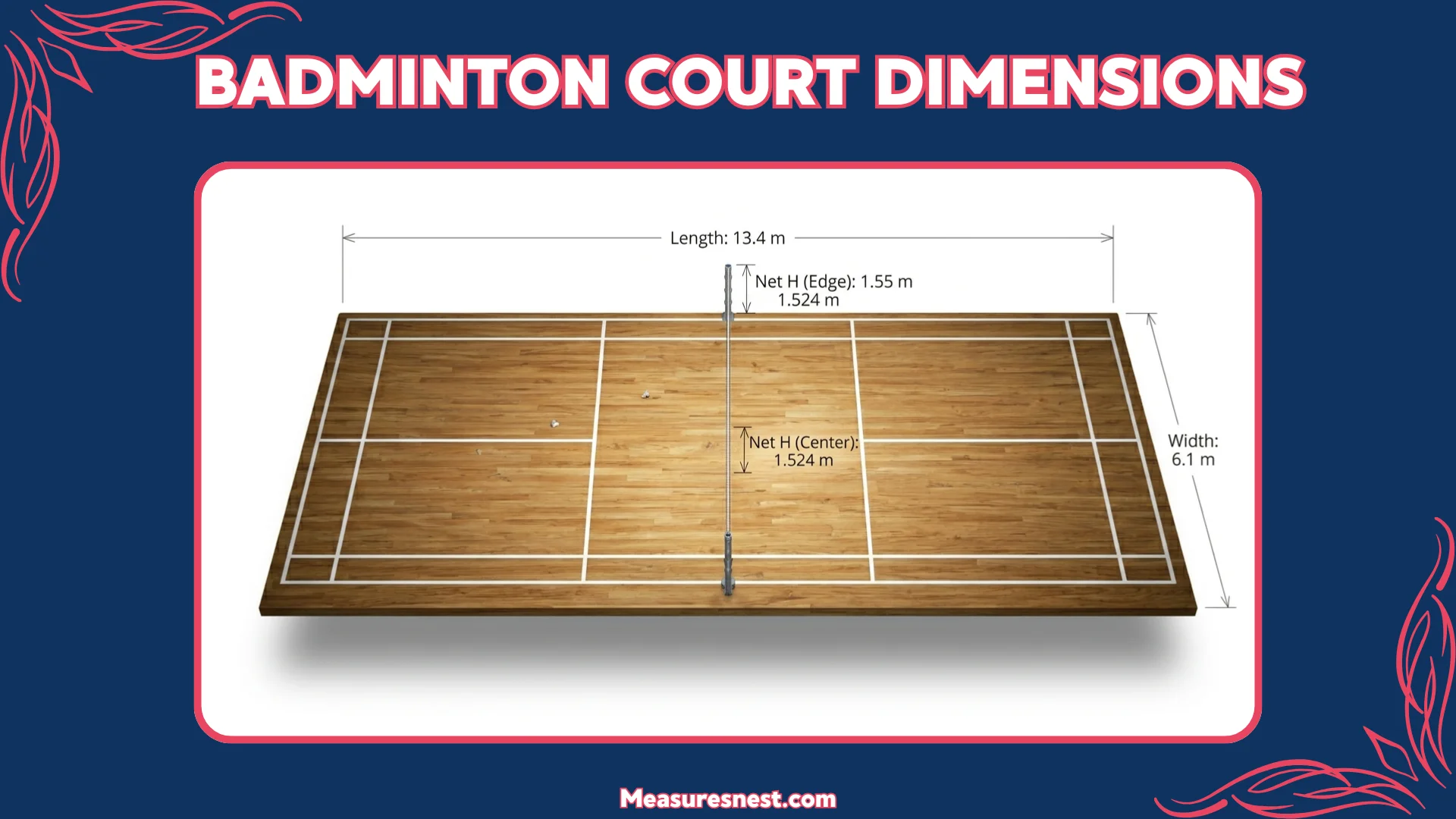
A regulation badminton court measures 44 feet (13.4 m) long and 20 feet (6.1 m) wide for doubles play. Singles matches use the same length but a narrower width of 17 feet (5.18 m). All lines on the court are 1.5 inches (38 mm) wide and count as part of the court area they define.
| Measurement | Feet | Meters | Inches | Centimeters |
|---|---|---|---|---|
| Full Court Length | 44 ft | 13.4 m | 528 in | 1,340 cm |
| Doubles Width | 20 ft | 6.1 m | 240 in | 610 cm |
| Singles Width | 17 ft | 5.18 m | 204 in | 518 cm |
| Short Service Line from Net | 6.5 ft | 1.98 m | 78 in | 198 cm |
| Long Service Line (Doubles) | 2.5 ft | 0.76 m | 30 in | 76 cm |
| Net Height (Center) | 5 ft | 1.524 m | 60 in | 152.4 cm |
| Net Height (Posts) | 5.08 ft | 1.55 m | 61 in | 155 cm |
| Line Width | 0.125 ft | 0.038 m | 1.5 in | 3.8 cm |
How Big Is A Badminton Court?
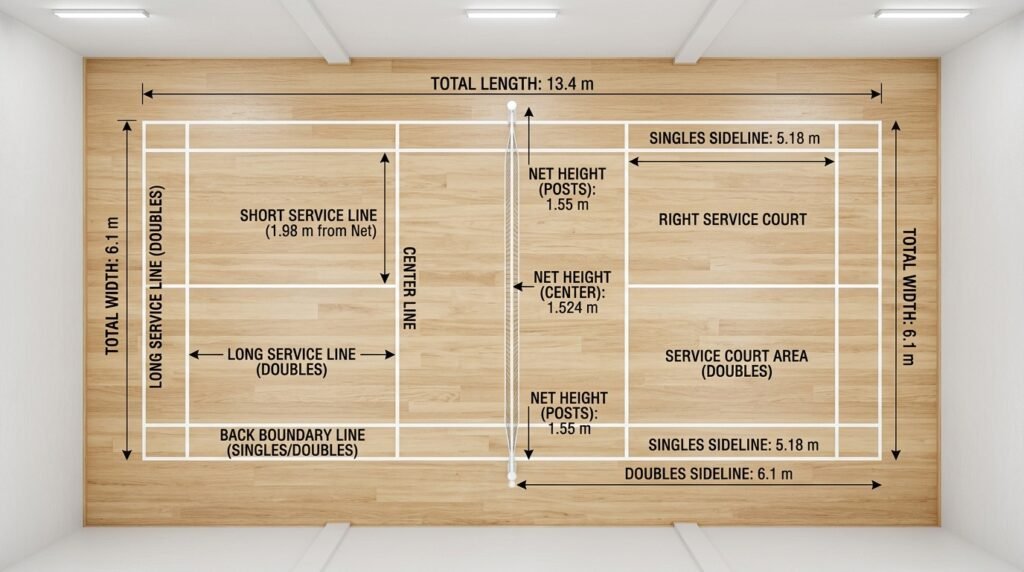
A full regulation badminton court covers 880 square feet (81.74 square meters) for doubles play. That’s roughly the size of a large one-car garage or a small studio apartment. The court feels deceptively compact until you start playing — then that 44-foot (13.4 m) length stretches fast.
Here’s how each court type breaks down:
Singles Court A singles court uses the full 44-foot (13.4 m) length but narrows to 17 feet (5.18 m) wide. The total singles playing area covers 748 square feet (69.5 square meters). This narrower width creates a faster, more physically demanding game that favors quick lateral movement and deep baseline shots.
Doubles Court The doubles court uses the full 44 feet (13.4 m) by 20 feet (6.1 m) dimensions, covering 880 square feet (81.74 square meters). Both side tramlines — the 1.5-foot (0.46 m) strips on each side — become active playing zones in doubles. Doubles uses a shorter service line at the rear of the court, reducing the long service zone to 2.5 feet (0.76 m) from the back boundary.
Badminton Court Size
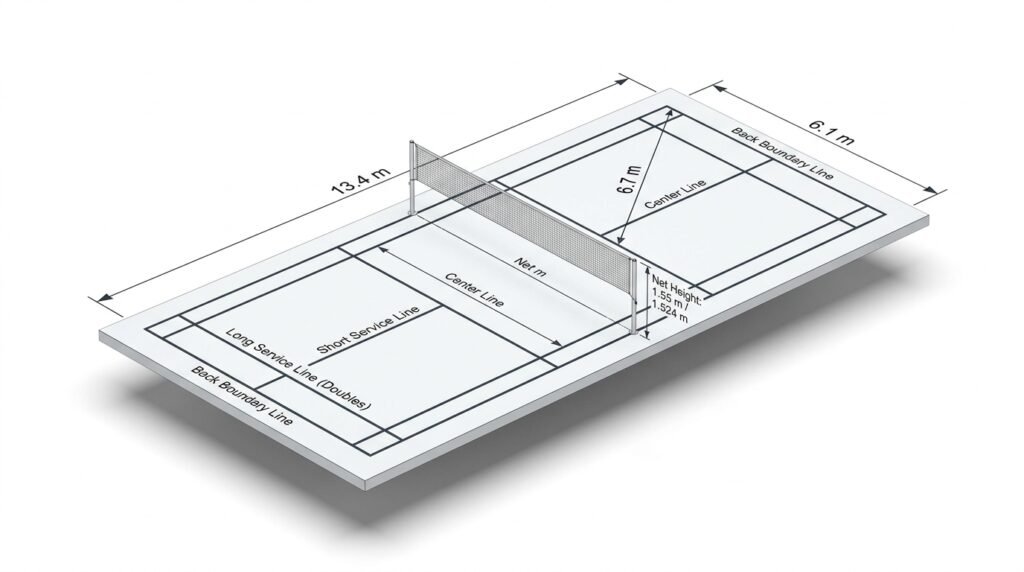
The full court measures 44 feet (13.4 m) long and 20 feet (6.1 m) wide — identical in length to a regulation volleyball court. The net divides the court exactly in half, giving each side a 22-foot (6.7 m) deep playing zone from the net to the back boundary line.
Each half of the court divides further into two service boxes — left and right — separated by a center line running from the short service line to the back boundary. Coaches and players use these boxes constantly during serve-and-return drills, strategy sessions, and match play.
Singles Court
The singles court measures 44 feet (13.4 m) long by 17 feet (5.18 m) wide. The side tramlines the outer 1.5-foot (0.46 m) strips running the full length of each side — fall out of bounds in singles play. However, the full 44-foot (13.4 m) length remains in play, including the back tramline at each end.
Professional singles players like Viktor Axelsen and An Se-young use every inch of that 17-foot (5.18 m) width to angle their shots and pull opponents off-center. The singles court’s narrower, longer shape rewards precise shot placement over power.
Doubles Court
The doubles court uses the full 44 feet (13.4 m) by 20 feet (6.1 m) playing area — all four tramlines active on every rally. The key difference from singles is the back service line: in doubles, the long service line sits 2.5 feet (0.76 m) inside the back boundary, making legal serves shorter and faster.
Olympic and championship doubles pairs train intensively on court positioning within this 880-square-foot (81.74 square meter) space. Understanding the exact 20-foot (6.1 m) width helps players and coaches map out rotation patterns and defensive coverage zones precisely.
Badminton Court Lines and Markings
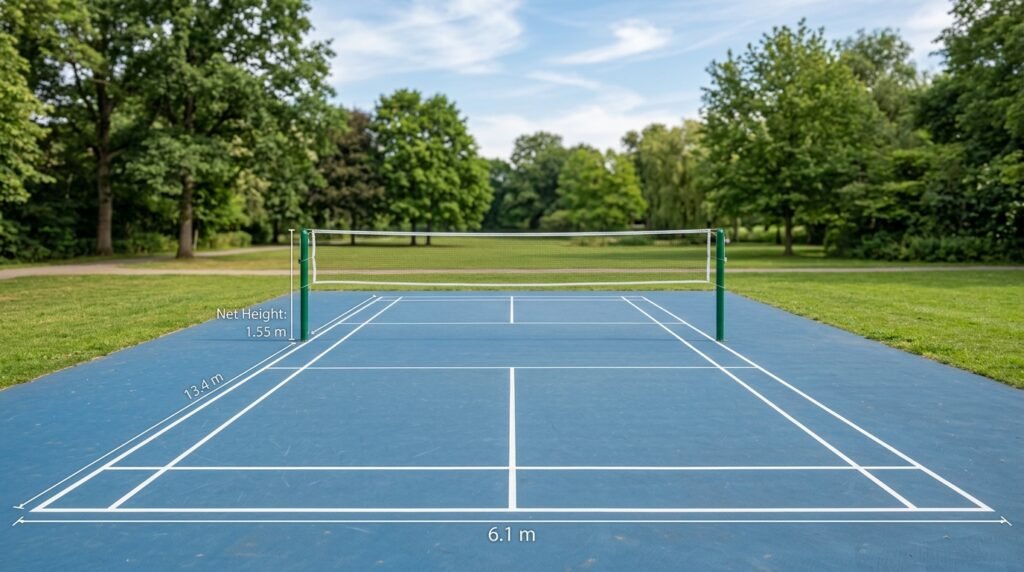
Every badminton court uses six key boundary and service lines, all drawn at 1.5 inches (38 mm) wide in a color that contrasts clearly with the court surface. The BWF requires that all lines be clearly visible from the player’s position and from the umpire’s chair throughout an entire match.
The six lines are: the outer side boundary (tramline), the singles side boundary, the center line, the short service line, the long service line for doubles, and the back boundary line. Each line sits precisely in its measured position — no estimation, no approximation. Tournament court crews measure and mark every line to the millimeter before official BWF events.
Badminton Net Height and Placement
The badminton net stretches across the full 20-foot (6.1 m) width of the court, supported by two posts standing exactly at the doubles sidelines. The net stands 5 feet 1 inch (1.55 m) tall at the posts and dips to exactly 5 feet (1.524 m) at the center due to the tension of the net cord.
The net itself measures 2.5 feet (0.76 m) deep from top to bottom and 20 feet (6.1 m) wide. The top edge features a 3-inch (7.62 cm) white tape folded over a cord or cable that keeps the top line taut and clearly visible. Net officials and court setup crews check net height with a calibrated net gauge at the center and at both posts before every sanctioned match.
Space Requirements for Your Badminton Court
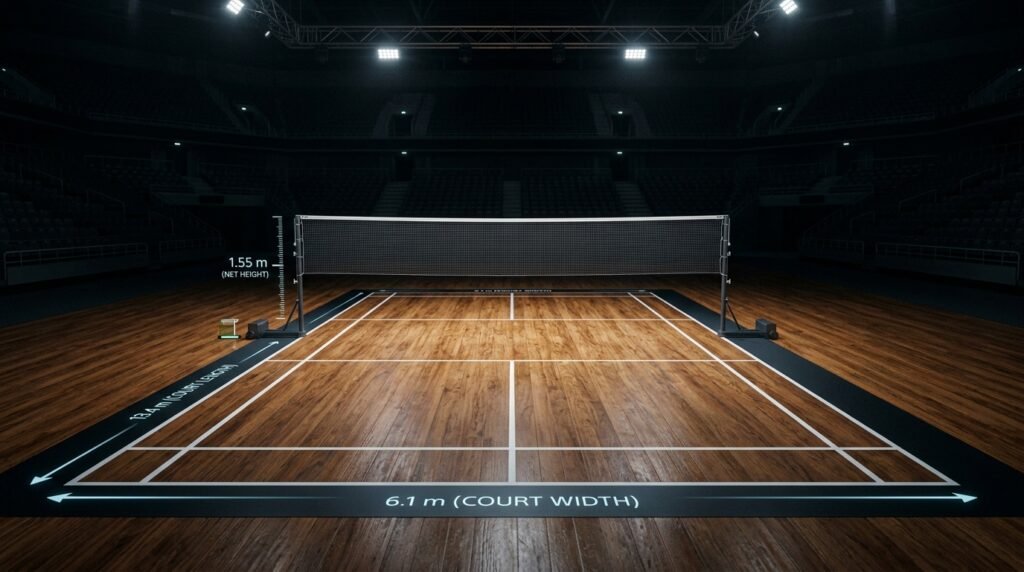
The BWF recommends a minimum overhead clearance of 26 feet (7.92 m) above the entire court surface for indoor play. Shuttle trajectories in competitive play frequently reach 20 feet (6.1 m) or higher on high clears and defensive lifts, making low ceilings a serious problem. Gymnasium designers and sports hall architects use the 26-foot (7.92 m) minimum as their starting point for any indoor badminton facility.
For safe side and back clearance around the court, the BWF recommends at least 4 feet (1.22 m) of free space beyond every boundary line. This buffer protects players from colliding with walls, fencing, or adjacent courts during fast retrieval shots. Facility managers at multi-court centers typically allow 5 to 6 feet (1.52 to 1.83 m) of clearance per court for player safety and spectator sightlines.
A single full-clearance badminton court therefore requires a total floor space of approximately 52 feet (15.85 m) long by 28 feet (8.53 m) wide around 1,456 square feet (135.3 square meters) including all safety buffers.
Badminton Court vs Pickleball Court
Many people notice that a badminton court and a pickleball court look similar at first glance but they differ in important ways. Here’s a direct comparison:
| Feature | Badminton Court | Pickleball Court |
|---|---|---|
| Length | 44 ft (13.4 m) | 44 ft (13.41 m) |
| Width (Doubles) | 20 ft (6.1 m) | 20 ft (6.1 m) |
| Width (Singles) | 17 ft (5.18 m) | 20 ft (6.1 m) |
| Net Height (Center) | 5 ft (1.524 m) | 34 in / 2.83 ft (86.4 cm) |
| Net Height (Posts) | 5 ft 1 in (1.55 m) | 36 in / 3 ft (91.4 cm) |
| Kitchen / Non-Volley Zone | None | 7 ft (2.13 m) each side |
| Service Box Structure | 4 boxes (left/right per side) | 2 boxes (left/right) |
| Overhead Clearance | 26 ft (7.92 m) min | 10 ft (3.05 m) min |
| Surface | Wood, synthetic, rubber | Concrete, asphalt, sports tile |
The court length and doubles width are almost identical between the two sports 44 feet (13.4 m) long and 20 feet (6.1 m) wide. The biggest differences are net height and service structure. Badminton nets stand almost twice as tall as pickleball nets at center court, and badminton uses four service boxes compared to pickleball’s two.
Frequently Asked Questions
What are the official badminton court dimensions in meters?
A regulation badminton court measures 13.4 meters (44 ft) long and 6.1 meters (20 ft) wide for doubles play. The singles width narrows to 5.18 meters (17 ft). The Badminton World Federation (BWF) sets these exact dimensions for all sanctioned international and recreational competitive play.
How high is a badminton net?
A badminton net stands 1.55 meters (5 ft 1 in) tall at the posts and 1.524 meters (5 ft) at the center. The slight dip at the center happens naturally due to net tension and is specified in BWF rules. Net officials check both measurements with a standard net gauge before every match.
How does a singles court differ from a doubles court?
A singles court uses the same 44-foot (13.4 m) length but narrows to 17 feet (5.18 m) wide, eliminating the outer side tramlines. A doubles court uses the full 20-foot (6.1 m) width with all side tramlines active. Doubles also uses a shorter rear service line, placing it 2.5 feet (0.76 m) inside the back boundary instead of at the boundary itself.
How much space do you need to build a badminton court? Y
ou need at least 52 feet (15.85 m) long by 28 feet (8.53 m) wide of total floor space when you include the BWF-recommended safety clearance buffers. That equals roughly 1,456 square feet (135.3 square meters) per court. Overhead clearance must reach at least 26 feet (7.92 m) above the court floor for safe indoor play.
Can a badminton court be used for pickleball?
Yes a badminton court converts to a pickleball court fairly easily because both courts share the same 44-foot (13.4 m) length and 20-foot (6.1 m) doubles width. You need to lower the net from 5 feet (1.524 m) to 34 inches (86.4 cm) at center and mark the 7-foot (2.13 m) non-volley kitchen zone. Many recreation centers use this dual-sport setup to maximize their court space.
What surface is best for a badminton court?
Wooden sprung floors like maple hardwood are the BWF’s preferred surface for international competition because they provide consistent bounce, grip, and player knee protection. Synthetic rubber and PVC sports flooring also meet BWF standards and work well for recreational and club facilities. Concrete and asphalt surfaces are not recommended for badminton because they increase joint impact and cause shuttlecock bounce inconsistencies.
Read: How Long Is 8 Inches?
Read: Bowling Lane Dimensions
Read: Can Koozie Dimensions
Read: Kitchen Trash Can Dimensions
Read: Dollar Bill Dimensions
Read: White Claw Can Dimensions
Conclusion
Badminton court dimensions follow strict BWF standards: 44 feet (13.4 m) long, 20 feet (6.1 m) wide for doubles, 17 feet (5.18 m) wide for singles, with a net standing 5 feet (1.524 m) at center and 5 feet 1 inch (1.55 m) at the posts. These badminton court dimensions cover 880 square feet (81.74 square meters) for doubles — similar in footprint to a large one-car garage.
Understanding badminton court dimensions means you can design a backyard or gym court accurately, convert an existing space for dual-sport use, and plan facility clearances that meet safety standards. Use these official measurements — the 44-foot length, the 20-foot doubles width, and the 26-foot overhead clearance requirement — when building, renovating, or booking court space for confident, code-compliant decisions.