Dollar Bill Dimensions: Size, Width, Height and Thickness 2026
Dollar bill dimensions measure exactly 6.14 inches long by 2.61 inches tall (15.6 cm by 6.63 cm) the same size used on every US banknote printed today. A dollar bill is slightly longer than a standard index card, almost exactly as wide as your palm, and fits precisely inside a standard bi-fold wallet.
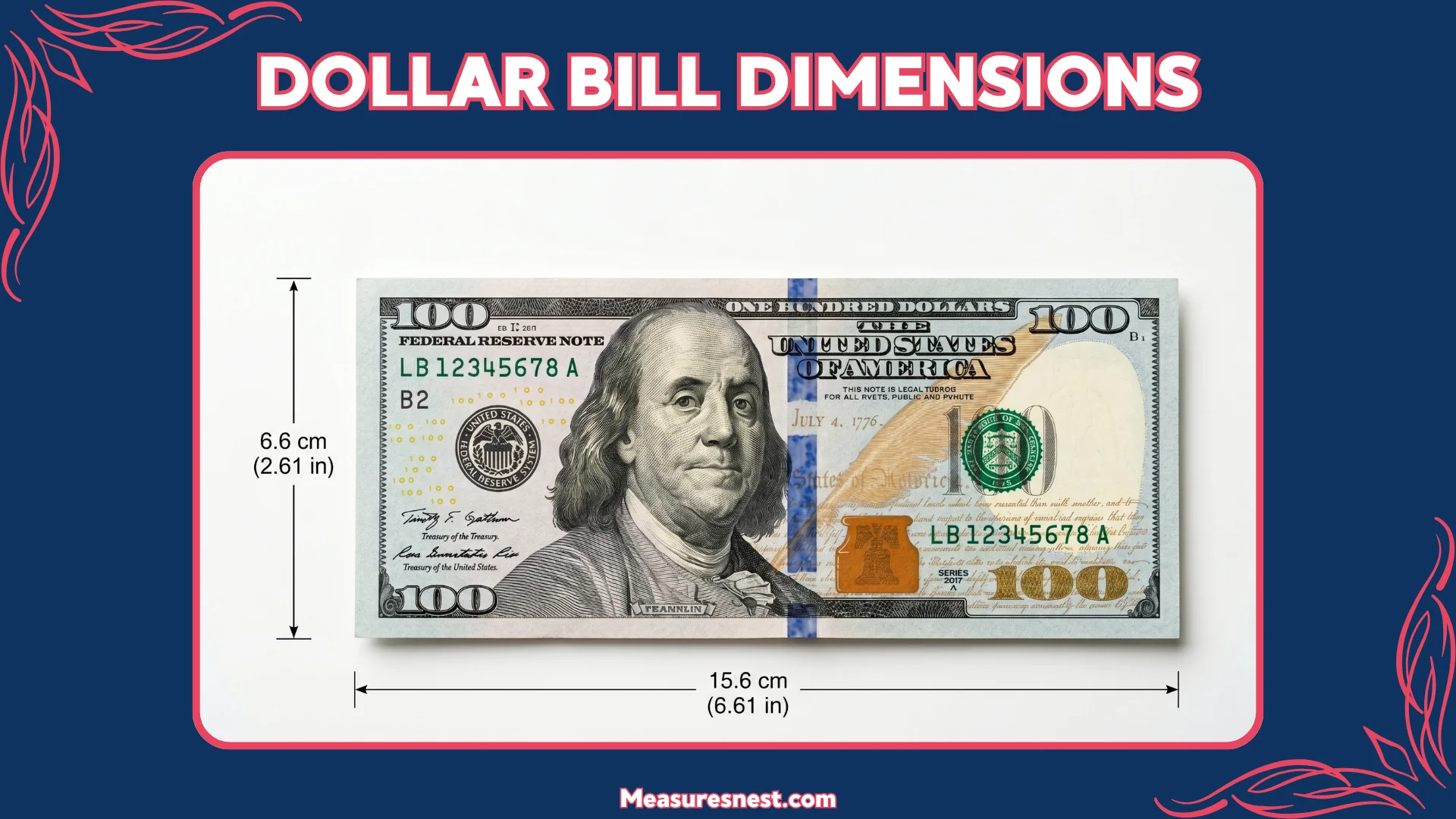
Whether you’re checking if a wallet fits your bills, crafting a DIY project using currency as a size reference, or simply curious about US currency, knowing exact dollar bill dimensions gives you an instant reference point.
What Are the Dollar Bill Dimensions?
Every US dollar bill from the $1 to the $100 shares the exact same physical dimensions. The US Bureau of Engraving and Printing has maintained these dollar bill dimensions since 1928.
| Measurement | Inches | Centimeters | Millimeters | Feet |
| Length (Width) | 6.14 in | 15.60 cm | 156.0 mm | 0.512 ft |
| Height | 2.61 in | 6.63 cm | 66.3 mm | 0.218 ft |
| Thickness | 0.0043 in | 0.109 mm | 0.109 mm | 0.000358 ft |
| Diagonal | 6.68 in | 16.97 cm | 169.7 mm | 0.557 ft |
| Area | 16.02 sq in | 103.4 sq cm | 10,339 sq mm | 0.111 sq ft |
These measurements apply to every denomination equally. Your $1, $5, $20, and $100 bills are all identical in size. Only the design and security features differ between denominations.
How Big Is A Dollar Bill?
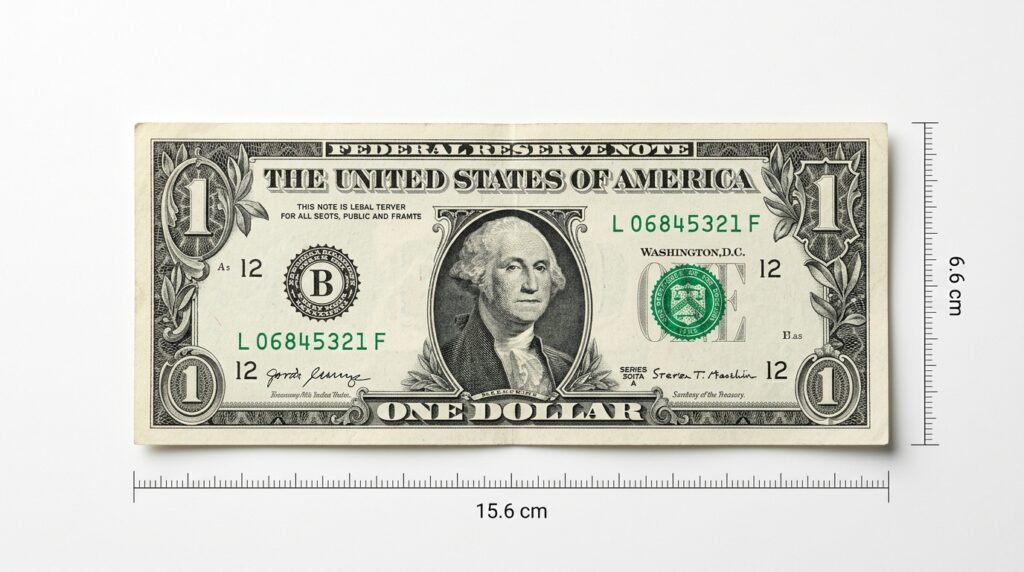
A dollar bill is exactly 6.14 inches long (15.6 cm) and 2.61 inches tall (6.63 cm). Picture a standard index card a dollar bill is just a little longer and a little shorter. It’s also almost exactly the same size as a standard playing card laid horizontally.
Your hand gives you the best body reference. For most adults, a dollar bill is almost exactly as wide as your palm from the base of your pinky to the base of your index finger. The height of the bill — 2.61 inches (6.63 cm) matches the width of three adult fingers held side by side.
Dollar Bill Height
The height of a dollar bill is exactly 2.61 inches (6.63 cm or 66.3 mm). This measurement runs from the top edge to the bottom edge of the bill. It’s consistent across every denomination and every print run since 1928.
To visualize 2.61 inches (6.63 cm), think of a standard AA battery. An AA battery stands 1.99 inches (5.05 cm) tall. Stack a battery upright and add a little over half an inch that’s the exact height of a dollar bill.
Wallet manufacturers design their card and bill slots around this precise 2.61-inch height (6.63 cm). A standard bi-fold wallet bill compartment is typically 3 to 3.5 inches tall (7.6 to 8.9 cm), giving your bills comfortable room with a little space on top.
Dollar Bill Width
The width (length) of a dollar bill is exactly 6.14 inches (15.6 cm or 156 mm). This is the longer horizontal measurement. It’s almost exactly the width of a standard business envelope, which measures 6.5 inches (16.5 cm) wide.
Six inches gives you a great mental benchmark. A dollar bill is just slightly longer than a standard 6-inch ruler. If you have a ruler nearby, you can see that the bill extends past the 6-inch mark (15.2 cm) by just about one-eighth of an inch (3 mm).
Cash register drawers, bank teller trays, and money clips are all designed around this 6.14-inch width (15.6 cm). Standard US letter envelopes hold dollar bills perfectly because of these precise dimensions.
Dollar Bill Thickness
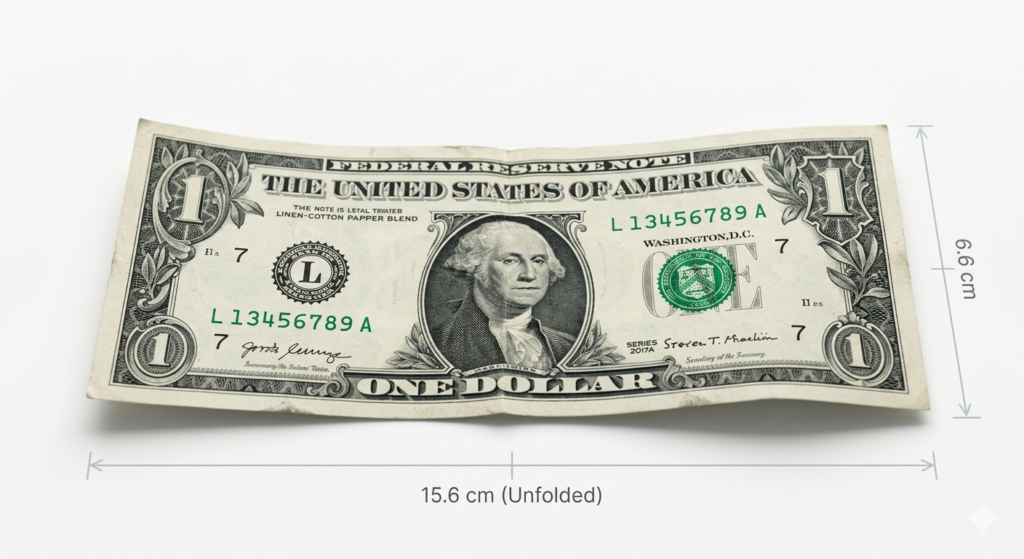
A single dollar bill is 0.0043 inches thick (0.109 mm). That is incredibly thin — thinner than a sheet of standard printer paper, which measures 0.004 inches (0.1 mm). You cannot measure a single bill’s thickness with a standard ruler.
Stacking bills makes the thickness easy to work with. Here’s what the numbers look like in practice:
| Number of Bills | Stack Thickness (inches) | Stack Thickness (mm) | Stack Thickness (cm) |
| 1 bill | 0.0043 in | 0.109 mm | 0.011 cm |
| 10 bills | 0.043 in | 1.09 mm | 0.109 cm |
| 100 bills | 0.43 in | 10.9 mm | 1.09 cm |
| 1,000 bills | 4.3 in | 109 mm | 10.9 cm |
| 10,000 bills | 43 in | 1,090 mm | 109 cm |
| 1,000,000 bills | 358 ft | 109,000 mm | 10,900 cm |
Bank tellers use this thickness to count large sums quickly. A 1-inch (2.54 cm) stack of bills contains about 233 bills. ATM machines use precise thickness sensors to count and verify each note as it loads.
Dollar Bill Material and Composition
US dollar bills are not made from regular paper. The Bureau of Engraving and Printing uses a special blend of 75% cotton and 25% linen. This blend makes bills far more durable than standard paper. A typical dollar bill lasts about 18 months (1.5 years) in circulation.
The material’s weight matters too. A single dollar bill weighs exactly 1 gram (0.035 ounces). This makes currency weight easy to calculate — 100 bills weigh exactly 100 grams (3.5 ounces), about the weight of a standard chocolate bar. One million dollars in $1 bills weighs 2,204 pounds (1,000 kg) — the weight of a small car.
The cotton-linen blend also gives bills their distinct feel and texture. Modern bills include embedded security threads, color-shifting ink, and microprinting that you can feel with your fingertips. Counterfeit detection pens work because fake bills use ordinary paper, which reacts differently to the iodine-based ink.
Dollar Bill Sizes
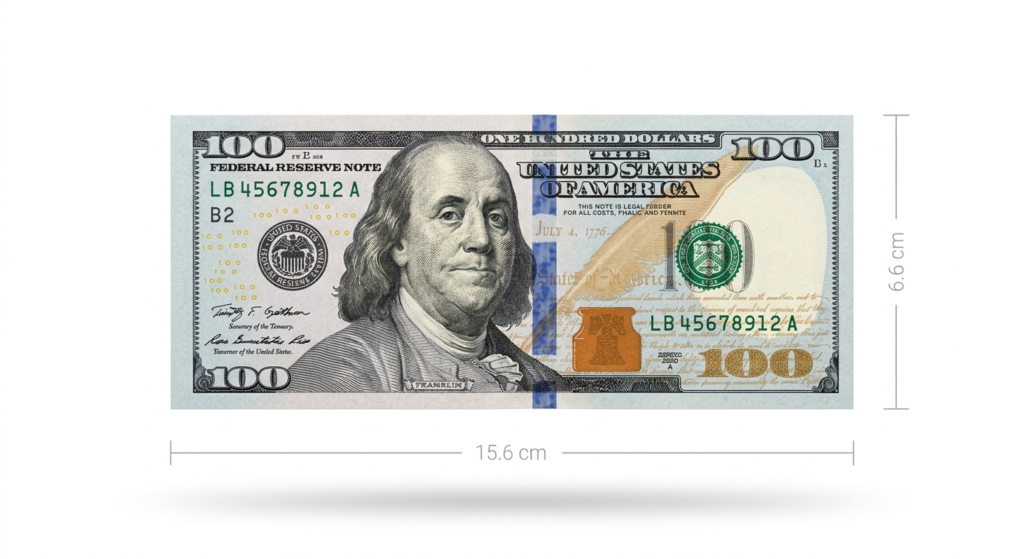
Every US denomination shares the same physical size. Here is the complete overview of all current US banknotes in 2026:
| Denomination | Length | Height | Thickness | First Printed | Avg Lifespan |
| $1 Bill | 6.14 in / 15.6 cm | 2.61 in / 6.63 cm | 0.0043 in / 0.109 mm | 1963 (current) | 18 months |
| $2 Bill | 6.14 in / 15.6 cm | 2.61 in / 6.63 cm | 0.0043 in / 0.109 mm | 1976 (current) | 6+ years |
| $5 Bill | 6.14 in / 15.6 cm | 2.61 in / 6.63 cm | 0.0043 in / 0.109 mm | 2008 (current) | 28 months |
| $10 Bill | 6.14 in / 15.6 cm | 2.61 in / 6.63 cm | 0.0043 in / 0.109 mm | 2004 (current) | 4.5 years |
| $20 Bill | 6.14 in / 15.6 cm | 2.61 in / 6.63 cm | 0.0043 in / 0.109 mm | 2009 (current) | 7.8 years |
| $50 Bill | 6.14 in / 15.6 cm | 2.61 in / 6.63 cm | 0.0043 in / 0.109 mm | 2004 (current) | 8.5 years |
| $100 Bill | 6.14 in / 15.6 cm | 2.61 in / 6.63 cm | 0.0043 in / 0.109 mm | 2013 (current) | 15 years |
The $100 bill lasts the longest about 15 years (180 months) because people save it rather than spend it daily. The $1 bill wears out fastest at 18 months due to constant everyday use in vending machines, tip jars, and cash registers.
Dollar Bill Dimensions vs Other Countries’ Currency
US dollar bill dimensions stand out compared to global currencies. Most other countries use larger, color-coded notes with size differences between denominations. Here’s how the US dollar compares:
| Currency | Country | Length | Height | Size vs USD |
| US Dollar ($) | United States | 6.14 in / 15.6 cm | 2.61 in / 6.63 cm | Baseline |
| Euro (€) | European Union | 4.88–5.83 in / 12.4–14.8 cm | 2.68 in / 6.8 cm | Shorter, taller |
| British Pound (£) | United Kingdom | 4.72–5.91 in / 12.0–15.0 cm | 2.56–3.15 in / 6.5–8.0 cm | Varies by denom. |
| Canadian Dollar (C$) | Canada | 5.51–6.30 in / 14.0–16.0 cm | 2.76 in / 7.0 cm | Similar length |
| Japanese Yen (¥) | Japan | 5.91–6.30 in / 15.0–16.0 cm | 2.76–3.23 in / 7.0–8.2 cm | Taller overall |
| Australian Dollar (A$) | Australia | 5.31–6.30 in / 13.5–16.0 cm | 2.60–3.15 in / 6.6–8.0 cm | Similar width |
| Swiss Franc (CHF) | Switzerland | 6.26–7.09 in / 15.9–18.0 cm | 2.76 in / 7.0 cm | Larger overall |
| Indian Rupee (₹) | India | 4.57–6.22 in / 11.6–15.8 cm | 2.17–2.56 in / 5.5–6.5 cm | Smaller overall |
The US dollar uses uniform sizing across all denominations a unique approach worldwide. The European Union uses graduated sizing, where higher-value euros are longer and taller. A 500 Euro note measures 5.83 inches long (14.8 cm) shorter than a dollar bill despite its much higher value.
Canada switched to polymer plastic banknotes in 2013. These notes are more durable and waterproof. They share a similar size to US dollars, making Canadian and US wallets interchangeable. Switzerland issues the largest standard banknotes in the world, with its higher denominations reaching 7.09 inches long (18 cm).
Measure Dollar Bill Dimensions Anywhere (No Ruler Needed!)
✋ Your Palm Width
Hold your dominant hand flat and relaxed. The distance across your palm — from the base of your pinky to the base of your index finger — is almost exactly 6 inches (15.2 cm) for most adults. A dollar bill at 6.14 inches (15.6 cm) is just a sliver wider than your palm.
💳 Standard Credit Card
A credit card measures exactly 3.37 inches long by 2.13 inches tall (8.56 cm by 5.40 cm). Place two credit cards end-to-end and they span 6.74 inches (17.1 cm) — close to a dollar bill’s 6.14 inches (15.6 cm). One card on its own gives you a perfect height comparison at 2.13 inches (5.4 cm) vs. a bill’s 2.61 inches (6.63 cm).
🍫 Chocolate Bar
A standard Hershey’s chocolate bar measures about 5.5 inches long (14 cm). A dollar bill is roughly the same length — just a little over half an inch longer. Line them up side by side and you’ll instantly see the 6.14-inch (15.6 cm) length of the bill.
📏 School Ruler
A standard 12-inch (30.5 cm) ruler is your best reference tool. A dollar bill extends to just past the 6-inch mark (15.2 cm) by about an eighth of an inch (3 mm). The bill’s 2.61-inch (6.63 cm) height falls between the 2.5-inch and 3-inch marks on the ruler.
Dollar Bill Dimensions Matter in Everyday Life
Buying a new wallet becomes much easier when you know exact dollar bill dimensions. A bill slot must be at least 6.14 inches wide (15.6 cm) and 2.61 inches tall (6.63 cm) knowing this saves you from buying a wallet that cramps your bills.
Crafting and DIY projects use dollar bills as a reliable measuring tool. A dollar bill is a perfectly consistent 6.14-inch ruler (15.6 cm) always available in your pocket with no tape measure needed.
Teaching kids about money connects better with physical size awareness. When children understand that every bill is the same size regardless of value, they grasp the concept of currency more quickly and confidently.
Designing packaging or compartments that hold currency requires exact specs. Engineers and product designers use the 6.14 by 2.61 inch measurement (15.6 by 6.63 cm) as a standard reference when creating cash drawers, donation boxes, and point-of-sale trays.
Read: White Claw Can Dimensions
Read: Aluminum Can Dimensions
Read: Slim Jim Trash Can Dimensions
Read: How Many Ounces in a Gallon
Read: Soup Can Dimensions
Read: Beer Can Dimensions
Frequently Asked Questions
How long is a dollar bill in inches and centimeters?
A dollar bill is exactly 6.14 inches long (15.6 cm or 156 mm). This measurement has stayed the same since the US standardized currency size in 1928. Every denomination from the $1 to the $100 shares this same length.
How wide (tall) is a dollar bill?
The height of a dollar bill measures exactly 2.61 inches (6.63 cm or 66.3 mm). This is the shorter edge of the bill — from the top to the bottom. It’s close to the width of three adult fingers held side by side.
How thick is a dollar bill?
A single dollar bill is 0.0043 inches thick (0.109 mm). You need about 233 bills to make a 1-inch-thick stack (2.54 cm). One million dollar bills stacked would reach 358 feet tall (109 meters) — taller than the Statue of Liberty from base to torch.
Are all US dollar bill sizes the same?
Yes — every US denomination uses exactly the same physical size: 6.14 inches by 2.61 inches (15.6 cm by 6.63 cm). The US adopted uniform sizing in 1928. Before that, bills were larger. Today the size is the same whether you hold a $1 or a $100 bill.
What is a dollar bill made of?
Dollar bills consist of 75% cotton and 25% linen — not ordinary paper. This blend makes bills resistant to tearing and moisture. The bills also contain embedded security threads, watermarks, and color-shifting ink. A dollar bill weighs exactly 1 gram (0.035 ounces).
How does the US dollar size compare to the Euro?
US dollars are longer but shorter in height than most euro banknotes. A dollar bill is 6.14 inches long (15.6 cm), while euro notes range from 4.88 to 5.83 inches (12.4 to 14.8 cm). Unlike the US, the EU uses graduated sizing — larger euros are physically bigger than smaller ones. A 500 Euro note is still shorter than a US dollar bill.
Conclusion
Dollar bill dimensions appear in your daily life through wallets, cash registers, ATMs, and everyday purchases. This precise measurement 6.14 inches long by 2.61 inches tall (15.6 cm by 6.63 cm) equals roughly the width of your palm or the length of two credit cards placed end to end.
Now that you know exact dollar bill dimensions, you can choose the right wallet with confidence, use a bill as a quick measuring tool, and understand how US currency compares to other countries.