Food Can Dimensions: Size, Width, Height & Diameter 2026
A standard #303 food can stands 4.375 inches (11.1 cm) tall and holds 15 to 16 oz (425 to 454 g) of food the most common size sitting on grocery store shelves across America. That height is roughly the same as a standard TV remote control, slightly taller than a deck of playing cards stood on its long edge, or about the width of an adult hand from pinky to thumb.
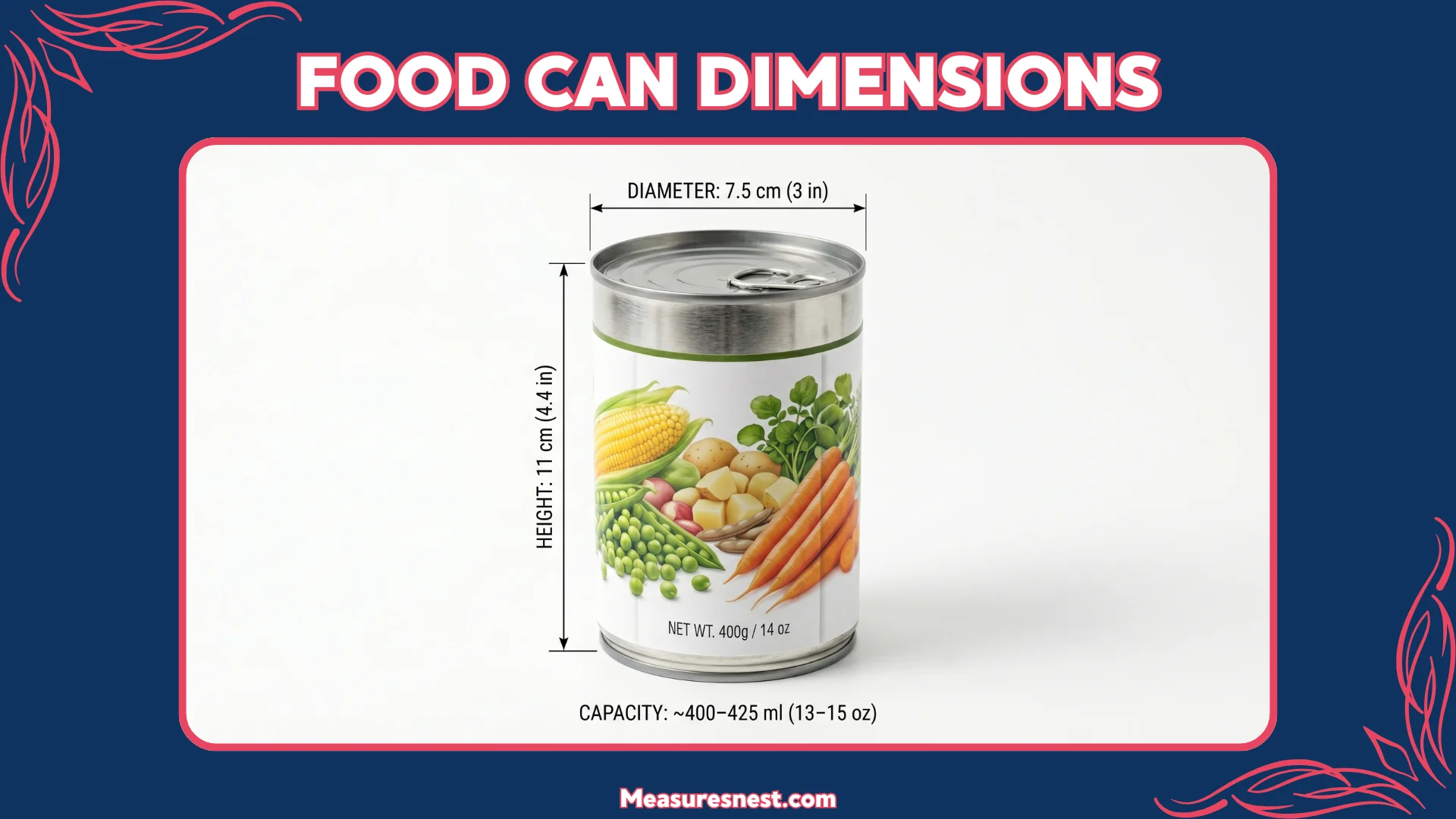
Whether you’re stocking a pantry, planning emergency food storage, or sourcing cans for commercial food production, knowing exact food can dimensions gives you an instant reference point.
Standard Food Can Sizes Chart
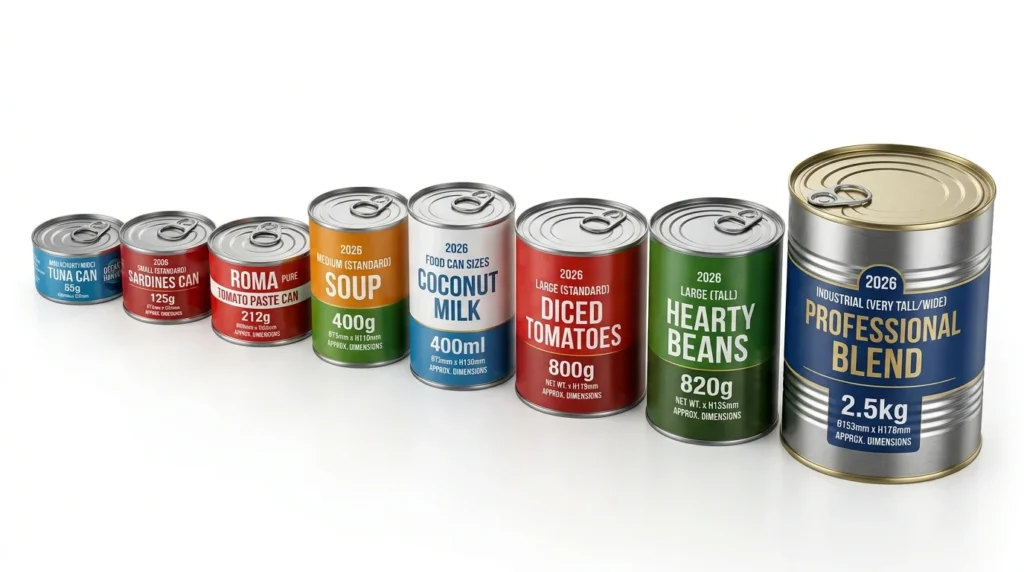
The US food canning industry uses a numbered system to label can sizes. These numbers come from the can’s physical dimensions not its volume or weight. A #10 can is not ten times larger than a #1 can; the numbers refer to lid diameter codes from older industry standards.
Every can size has a standardized height, diameter, and typical volume range. Actual weight varies by food type a dense product like tomato paste fills the same can space as a lighter product like green beans but weighs significantly more.
| Can Size | Diameter | Height | Typical Volume | Common Food |
|---|---|---|---|---|
| #10 | 6.188 in (15.7 cm) | 7.0 in (17.8 cm) | 109 oz / 6 lb 9 oz (3.1 kg) | Institutional sauces, fruits |
| #5 | 5.313 in (13.5 cm) | 5.563 in (14.1 cm) | 56 oz (1.6 kg) | Juice, tomatoes |
| #303 | 3.0625 in (7.8 cm) | 4.375 in (11.1 cm) | 15–16 oz (425–454 g) | Vegetables, fruits, beans |
| #300 | 3.0 in (7.6 cm) | 4.375 in (11.1 cm) | 14–16 oz (397–454 g) | Specialty vegetables |
| #401 | 4.25 in (10.8 cm) | 4.875 in (12.4 cm) | 28–29 oz (794–822 g) | Whole tomatoes, peaches |
| #2 | 3.375 in (8.6 cm) | 4.5625 in (11.6 cm) | 20 oz (567 g) | Fruit, pineapple |
| #1 (Picnic) | 2.6875 in (6.8 cm) | 4.0 in (10.2 cm) | 10.5–12 oz (298–340 g) | Soups, meats |
| 5 oz Flat | 2.4375 in (6.2 cm) | 1.875 in (4.8 cm) | 5 oz (142 g) | Tuna, salmon |
| 8 oz Short | 3.0625 in (7.8 cm) | 2.875 in (7.3 cm) | 8 oz (227 g) | Tomato sauce, specialty |
| 14 oz Tall | 3.0625 in (7.8 cm) | 4.0 in (10.2 cm) | 14 oz (397 g) | Coconut milk, broth |
Detailed Breakdown of Common Can Sizes
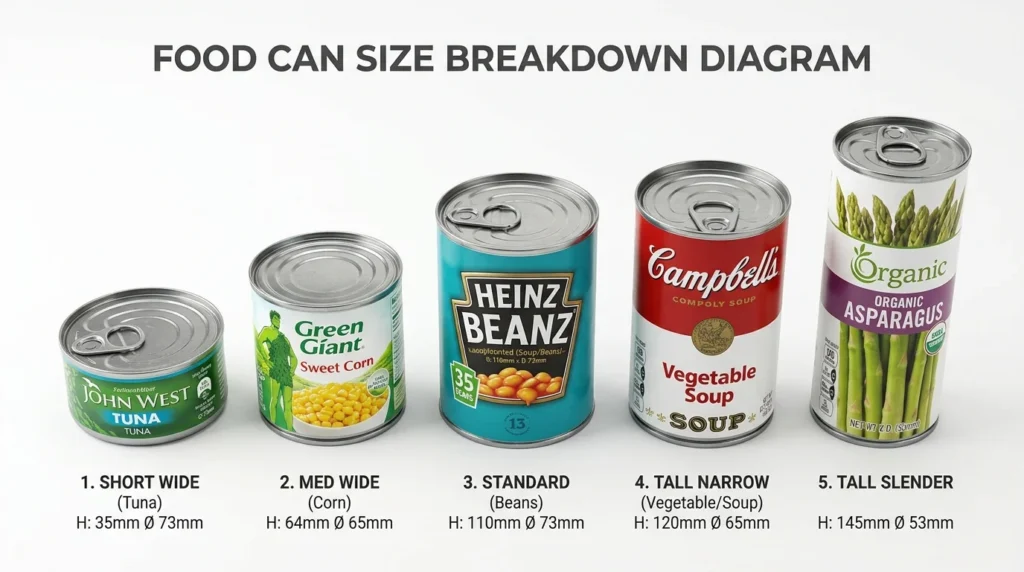
Each can size serves a specific food type and consumer need. Restaurant supply managers, home canners, and emergency preparedness planners all track these dimensions carefully. Here is a complete look at each major format.
#10 Can Dimensions
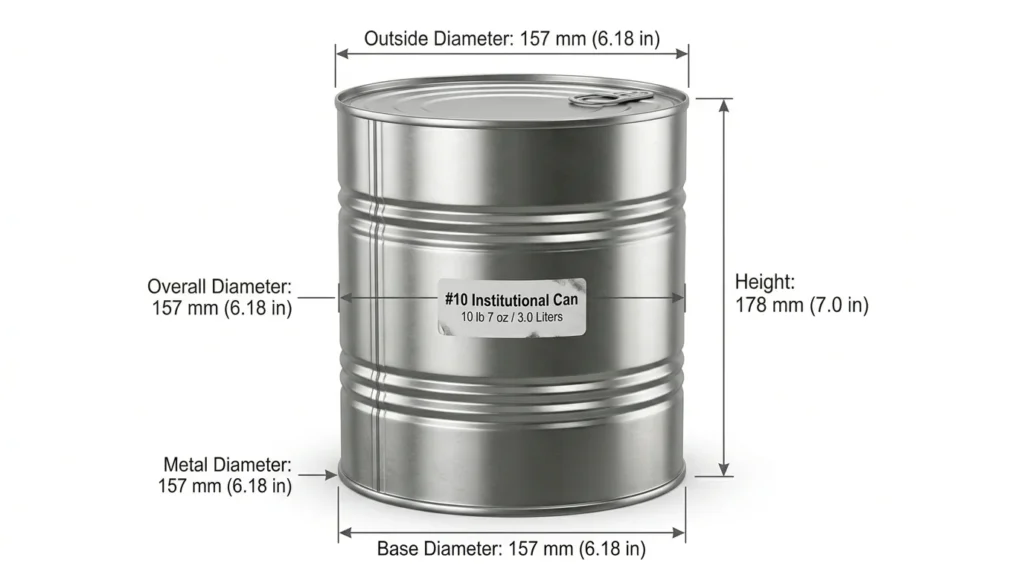
The #10 can is the largest standard food can in common use. You find it in restaurant kitchens, school cafeterias, and institutional food service operations worldwide.
Exterior Dimensions:
- Diameter: 6.188 inches (15.7 cm / 157 mm)
- Height: 7.0 inches (17.8 cm / 178 mm)
- Circumference: 19.44 inches (49.4 cm)
Volume and Weight:
- Volume: approximately 109 fluid oz (3.22 liters)
- Net weight: varies from 6 lb 4 oz to 7 lb 5 oz (2.8 to 3.3 kg) depending on food density
The #10 can stands exactly as tall as a standard wine bottle’s lower half. Its 6.188-inch (15.7 cm) diameter means you need both hands to wrap around it comfortably. Professional chefs use these cans for bulk sauces, sliced fruits, and whole tomatoes in high-volume kitchens.
A single #10 can of tomato sauce fills approximately 13 cups (3.1 liters) enough for 6 to 8 large pasta dishes. Food banks, disaster relief organizations, and military mess kitchens rely on #10 cans daily. The 7.0-inch (17.8 cm) height allows three cans to stack in a standard 24-inch (61.0 cm) pantry shelf.
#300 Can Dimensions
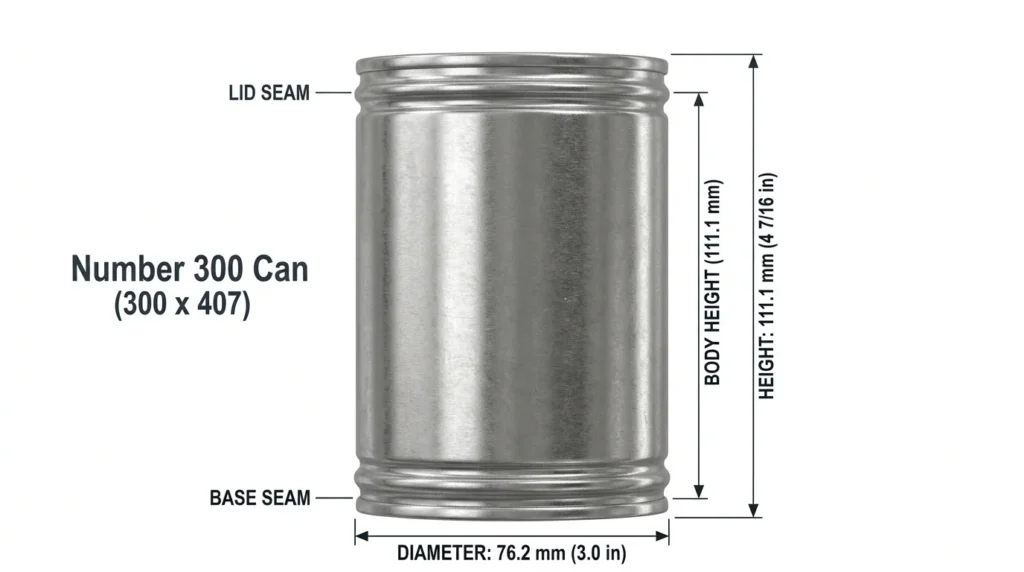
The #300 can is slightly narrower than the #303 and holds a touch less volume. You will find it used for specialty vegetables, some soups, and select fruit products.
Exterior Dimensions:
- Diameter: 3.0 inches (7.6 cm / 76.2 mm)
- Height: 4.375 inches (11.1 cm / 111 mm)
- Circumference: 9.42 inches (23.9 cm)
Volume and Weight:
- Volume: approximately 14 to 16 oz (397 to 454 g)
- Net weight: varies by food type
At 3.0 inches (7.6 cm) in diameter, the #300 can is just slightly narrower than a standard baseball at 2.9 inches (7.4 cm). Your hand wraps around it comfortably with fingers overlapping slightly. Specialty food producers use this can for premium and artisan products where the slightly narrower profile signals a differentiated product on shelf.
The #300 and #303 cans share the same 4.375-inch (11.1 cm) height but differ by just 0.0625 inches (1.6 mm) in diameter. Side by side, they look nearly identical. The key difference shows up in interior volume the #300 holds approximately 14 to 15 oz (397 to 425 g) versus the #303’s 15 to 16 oz (425 to 454 g).
#303 Can Dimensions
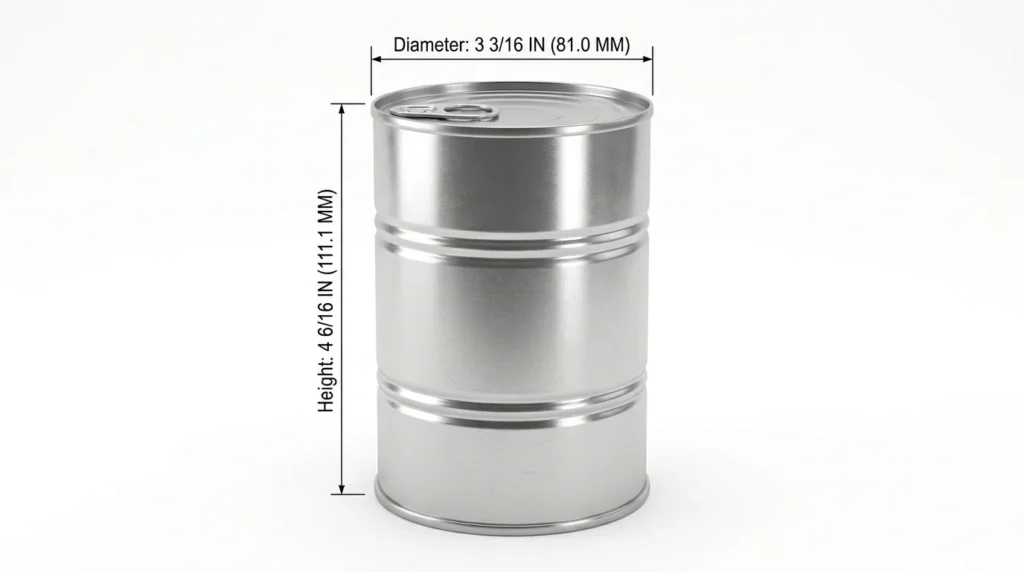
The #303 can is the single most common food can format in American retail grocery. It holds virtually every canned vegetable, bean, and fruit you buy at the supermarket.
Exterior Dimensions:
- Diameter: 3.0625 inches (7.78 cm / 77.8 mm)
- Height: 4.375 inches (11.1 cm / 111 mm)
- Circumference: 9.62 inches (24.4 cm)
Volume and Weight:
- Volume: approximately 15 to 16 oz (425 to 454 g)
- Typical net weight: 14.5 to 15.5 oz (411 to 439 g)
The #303 can stands almost exactly as tall as the distance from your wrist crease to your middle knuckle on most adult hands. Its 3.0625-inch (7.78 cm) diameter fits perfectly in a standard kitchen cabinet with two cans sitting side by side in 6.125 inches (15.6 cm) of space. Home cooks, dietitians, and grocery buyers work with this exact format every single day.
Americans purchase over 25 billion #303-equivalent cans of food annually. Chefs use the 4.375-inch (11.1 cm) height as a quick reference three #303 cans stacked equal just over 13 inches (33.0 cm), close to the height of a standard cereal box. The #303 format also fits perfectly in most can organizers, lazy susans, and rotating pantry shelf systems.
#401 Can Dimensions
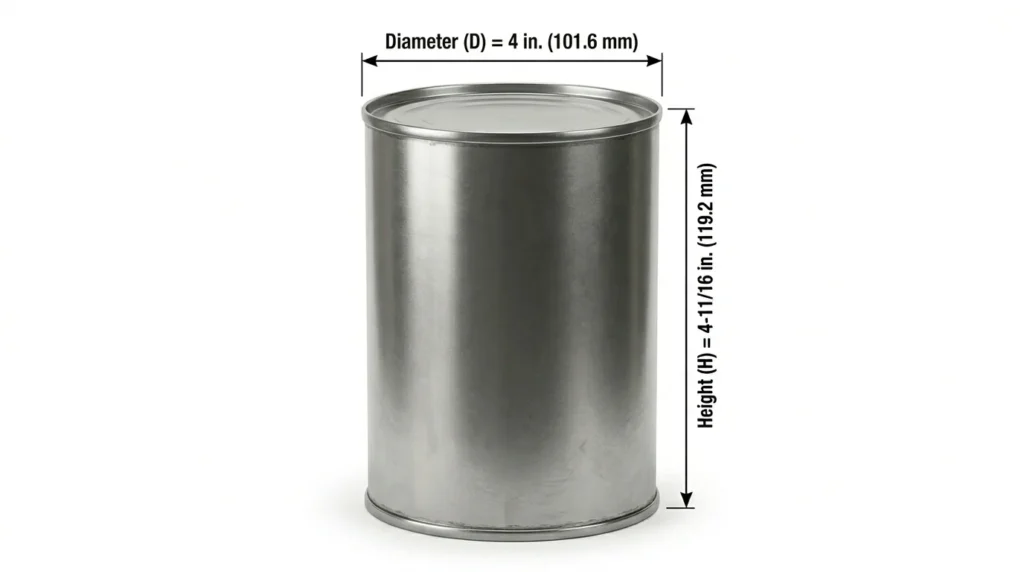
The #401 can is the large standard retail can bigger than the everyday #303 but smaller than institutional #10 cans. You find it holding whole tomatoes, peach halves, fruit cocktail, and large vegetable portions.
Exterior Dimensions:
- Diameter: 4.25 inches (10.8 cm / 108 mm)
- Height: 4.875 inches (12.4 cm / 124 mm)
- Circumference: 13.35 inches (33.9 cm)
Volume and Weight:
- Volume: approximately 28 to 29 oz (794 to 822 g)
- Typical net weight: 26 to 28 oz (737 to 794 g)
The #401 can is noticeably wider than the #303 nearly 1.2 inches (3.0 cm) wider in diameter. Holding one in each hand, you immediately feel the size jump. Home cooks use the #401 format for slow cooker meals, large batch cooking, and family-size portions where a single can serves four or more people.
The 4.875-inch (12.4 cm) height sits just under 5 inches (12.7 cm) slightly taller than a deck of cards standing on its long edge. Its 4.25-inch (10.8 cm) diameter means it does not fit neatly into standard can organizers designed for #303 cans. Store #401 cans on their own shelf section or in dedicated pantry bins.
12 oz, 15 oz, 16 oz, and 28 oz Can Dimensions
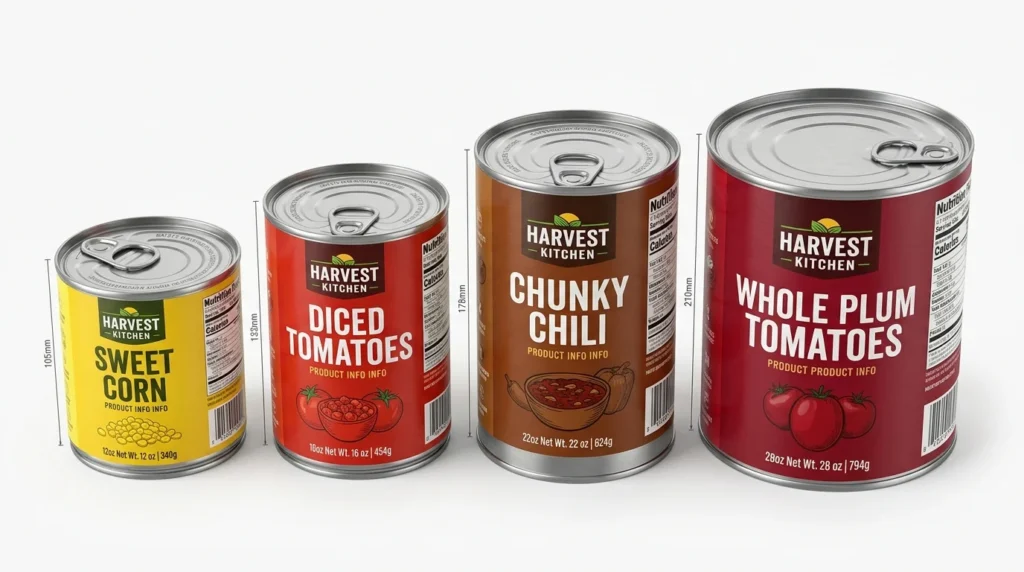
These four weight-labeled sizes are the ones most Americans know from everyday shopping. They map closely to the numbered can system but are sold by net weight on the label.
12 oz Can (approx. #1 Tall):
- Diameter: 2.6875 inches (6.83 cm / 68.3 mm)
- Height: 4.25 inches (10.8 cm / 108 mm)
- Common foods: evaporated milk, specialty soups, corned beef
15 oz Can (standard #303):
- Diameter: 3.0625 inches (7.78 cm / 77.8 mm)
- Height: 4.375 inches (11.1 cm / 111 mm)
- Common foods: beans, corn, green beans, diced tomatoes
16 oz Can (large #303):
- Diameter: 3.0625 inches (7.78 cm / 77.8 mm)
- Height: 4.6875 inches (11.9 cm / 119 mm)
- Common foods: baked beans, fruit, pumpkin puree
28 oz Can (#401):
- Diameter: 4.25 inches (10.8 cm / 108 mm)
- Height: 4.875 inches (12.4 cm / 124 mm)
- Common foods: whole peeled tomatoes, crushed tomatoes, fruit cocktail
The 15 oz and 16 oz cans share the same 3.0625-inch (7.78 cm) diameter. The only difference is the 16 oz can stands 0.3125 inches (7.9 mm) taller. Side by side they look nearly identical until you measure the height difference. The 28 oz can is immediately distinct nearly 1.2 inches (3.0 cm) wider than the 15 oz format.
Smaller Specialty Sizes (e.g., 5 oz, 8 oz, 14 oz)
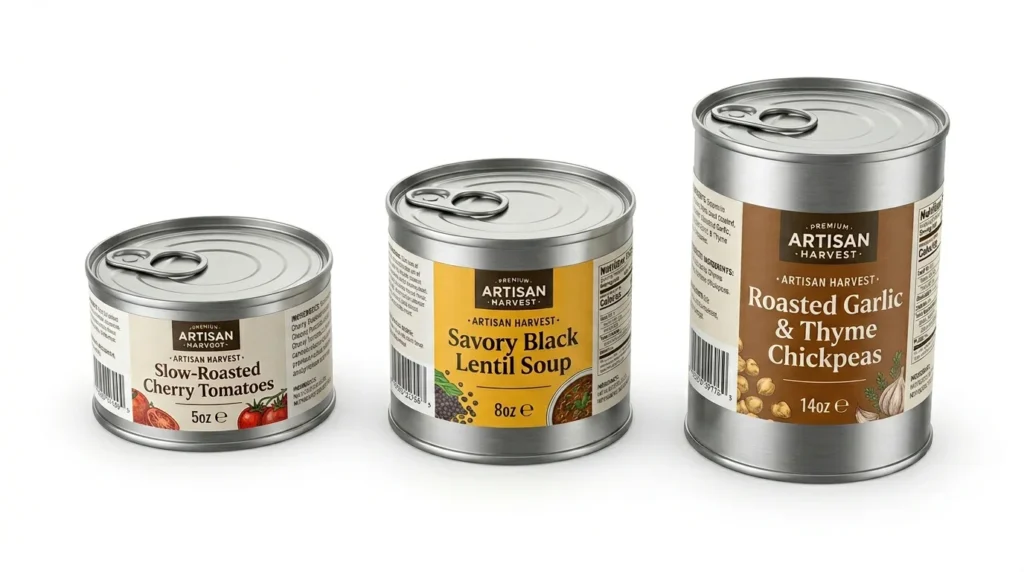
Smaller specialty cans serve specific food categories where portion size, food type, or consumer preference demands a compact format. These cans appear in the canned fish, specialty sauce, and imported food aisles.
5 oz Flat Can (tuna/salmon format):
- Diameter: 3.3125 inches (8.41 cm / 84.1 mm)
- Height: 1.3125 inches (3.33 cm / 33.3 mm)
- Used for: canned tuna, salmon, sardines, crab
- This can is wider than it is tall flatter than a hockey puck
8 oz Short Can:
- Diameter: 3.0625 inches (7.78 cm / 77.8 mm)
- Height: 2.875 inches (7.3 cm / 73.0 mm)
- Used for: tomato sauce, specialty sauces, condensed soups
- This format is exactly the height of a standard billiard ball in diameter
14 oz Tall Specialty Can:
- Diameter: 3.0625 inches (7.78 cm / 77.8 mm)
- Height: 4.0 inches (10.2 cm / 102 mm)
- Used for: coconut milk, sweetened condensed milk, specialty broths
- Shares the same diameter as the #303 but stands slightly shorter
The 5 oz flat can is the most distinctive format at just 1.3125 inches (3.33 cm) tall, it is barely taller than a US quarter standing on edge. Its wide, flat shape stacks efficiently in refrigerator doors and drawer-style pantry systems. Seafood brands, budget shoppers, and high-protein diet followers use this format most.
Volume vs. Weight
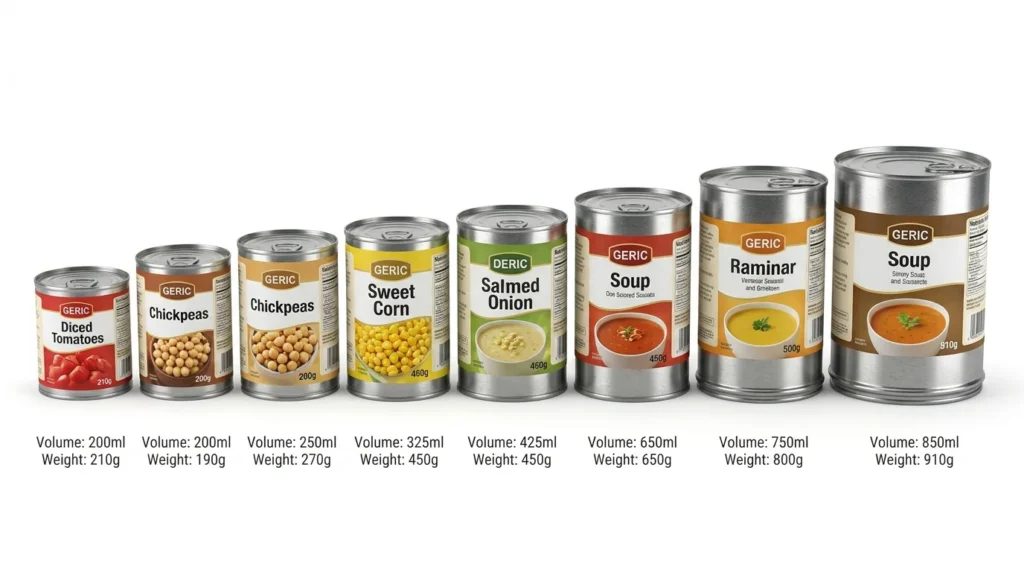
Food can labels list net weight not volume. That distinction matters when you cook or plan storage.
Net weight tells you how much food is inside including liquid. Drained weight tells you how much solid food remains after you pour off the liquid. The difference can be significant.
| Can Size | Labeled Net Weight | Typical Drained Weight | Liquid % |
|---|---|---|---|
| #303 green beans | 14.5 oz (411 g) | 8–9 oz (227–255 g) | ~40% |
| #303 kidney beans | 15 oz (425 g) | 9–10 oz (255–283 g) | ~35% |
| #401 whole tomatoes | 28 oz (794 g) | 20–22 oz (567–624 g) | ~25% |
| 5 oz tuna (in water) | 5 oz (142 g) | 4–4.5 oz (113–128 g) | ~15% |
| #10 sliced peaches | 109 oz (3.09 kg) | 70–75 oz (1.98–2.13 kg) | ~35% |
Volume and net weight also diverge based on food density. A #303 can of tomato paste and a #303 can of green beans have identical dimensions but very different net weights. Tomato paste at 6 oz (170 g) fills the same can space as green beans at 14.5 oz (411 g) because paste is far denser and fills every gap while beans leave air pockets and liquid space.
When planning emergency food storage, use calories per can not just net weight or can size. Two identical #303 cans of different foods can vary by 200 to 400 calories based on food type and density.
How to Measure a Food Can Yourself
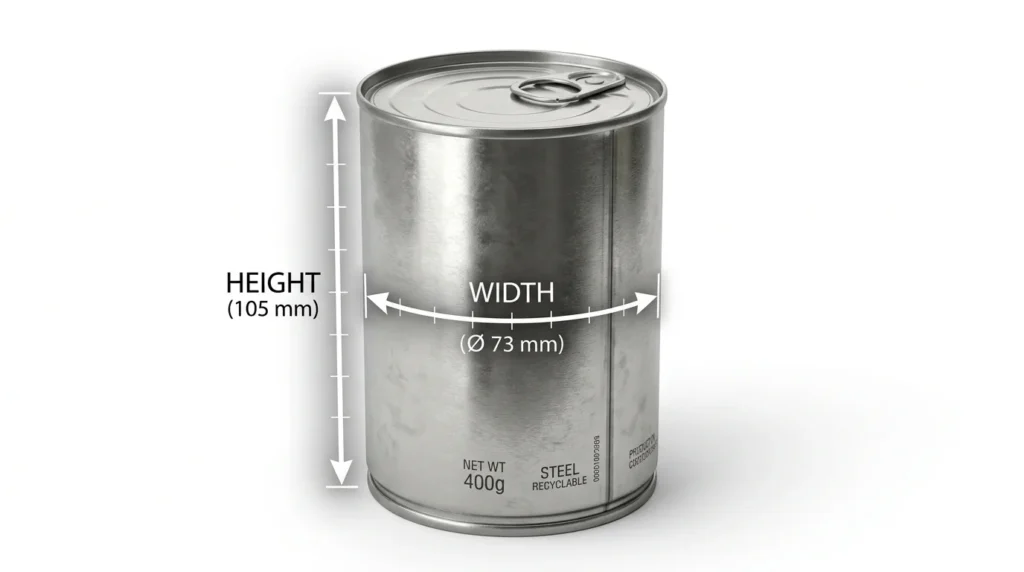
You do not need special tools to measure a food can accurately. A standard ruler or tape measure handles every dimension you need.
Measuring Diameter: Place the can upright on a flat surface. Lay a ruler across the top of the can through the exact center. The widest point across the lid gives you the diameter. For a standard #303 can, you should read exactly 3.0625 inches (7.78 cm).
Measuring Height: Stand the can upright. Place one end of your ruler at the very base of the can not on the seam rim. Measure straight up to the very top of the lid rim. A standard #303 reads 4.375 inches (11.1 cm).
Checking Circumference: Wrap a flexible tape measure or a strip of paper around the widest part of the can body. Mark where the tape meets itself and measure that length flat. A #303 circumference reads approximately 9.62 inches (24.4 cm).
Estimating Without a Ruler:
🖐️ Your Hand Span An adult hand span from pinky tip to thumb tip measures about 7 to 9 inches (17.8 to 22.9 cm). A #303 can held upright sits just over half your hand span in height. Use this to quickly eyeball whether a can matches the standard 4.375-inch (11.1 cm) format.
🥫 Stack and Compare Three #303 cans stacked reach just over 13 inches (33.0 cm). A standard ruler is 12 inches (30.5 cm). Three stacked #303 cans stand about 1 inch (2.54 cm) taller than your ruler a quick visual check that is easy to remember.
🍕 Pizza Reference A personal pizza measures about 6 inches (15.2 cm) in diameter. A #10 institutional can at 6.188 inches (15.7 cm) is almost exactly the same width as a personal pizza. Use that comparison to instantly picture the largest standard food can format.
⚾ Baseball A regulation baseball measures 2.9 inches (7.4 cm) in diameter. The #303 can at 3.0625 inches (7.78 cm) is almost exactly the same width as a baseball. Roll a baseball next to a standing #303 can and the match is striking.
Read: Ammo Can Dimensions
Read: Pokémon Card Dimensions
Read: Standard Chips Bag Size
Read: Magazine Dimensions
Read: Wheelchair Dimensions
Read: Coffee Can Dimensions
Frequently Asked Questions
What are the dimensions of a standard #303 food can?
A standard #303 food can measures 3.0625 inches (7.78 cm) in diameter and 4.375 inches (11.1 cm) tall. It holds approximately 15 to 16 oz (425 to 454 g) of food including liquid. This is the most common food can format on US grocery store shelves, used for vegetables, beans, and fruits.
How big is a #10 can?
A #10 can measures 6.188 inches (15.7 cm) in diameter and 7.0 inches (17.8 cm) tall. It holds approximately 109 oz (3.09 liters / 6 lb 9 oz) of food. This institutional-size format is used in restaurants, schools, food banks, and emergency food storage programs.
What is the difference between a #300 and #303 food can?
The #300 can measures 3.0 inches (7.6 cm) in diameter while the #303 measures 3.0625 inches (7.78 cm). Both share the same 4.375-inch (11.1 cm) height. The #303 holds slightly more approximately 15 to 16 oz (425 to 454 g) versus the #300’s 14 to 15 oz (397 to 425 g).
How tall is a 28 oz food can?
A 28 oz food can (#401 format) stands 4.875 inches (12.4 cm) tall with a diameter of 4.25 inches (10.8 cm). It is noticeably wider than the standard #303 can. You will find this size holding whole tomatoes, peach halves, and large-portion vegetables at most grocery stores.
What are the dimensions of a tuna can?
A standard 5 oz tuna can measures 3.3125 inches (8.41 cm) in diameter and 1.3125 inches (3.33 cm) tall. Its flat, wide disc shape makes it unlike any other common food can format. The drained weight of a 5 oz tuna can is typically 4 to 4.5 oz (113 to 128 g) of solid fish after draining the liquid.
How do I measure a food can without a ruler?
Use a dollar bill it measures exactly 6.14 inches (15.6 cm) long and 2.61 inches (6.6 cm) wide. A standard #303 can diameter of 3.0625 inches (7.78 cm) is just slightly wider than the short side of a dollar bill. For height, two stacked #303 cans reach just under 9 inches (22.9 cm) close to the long side of a standard sheet of paper at 11 inches (27.9 cm).
Conclusion
Food can dimensions appear in your kitchen every day through the #303 vegetable can, the #401 tomato can, the 5 oz tuna flat, and the giant #10 institutional can. This practical measurement system ranging from 1.3125 inches (3.33 cm) tall for a tuna flat to 7.0 inches (17.8 cm) for a #10 can organizes billions of food units across American pantries, restaurants, and food banks in 2026.
Now that you know exact food can dimensions, you can plan pantry storage precisely, compare net weight versus drained weight accurately, and identify any can format by size alone without reading the label.